
Rubber Materials Expertise
Rubber Materials
Rubber materials play a critical role in modern manufacturing, providing durability, flexibility, and resistance to extreme conditions across a wide range of industries. From sealing and insulation to vibration control and fluid handling, rubber components are essential in ensuring the performance and reliability of industrial systems.
Different rubber materials offer specific properties depending on the application. Some are designed to withstand high temperatures, while others provide excellent chemical resistance, flexibility, or abrasion resistance. Selecting the right rubber material is therefore crucial to achieving long-term performance and maintaining operational safety.
Common rubber materials used in industrial applications include EPDM, Nitrile (NBR), Silicone, FKM (Viton), and Natural Rubber. Each type offers unique characteristics. For example, EPDM rubber materials provide excellent resistance to weather, ozone, and aging, making them ideal for outdoor applications. Nitrile rubber materials are widely used where resistance to oils and fuels is required, while silicone rubber materials perform well in extreme temperature environments.
In sectors such as aerospace, manufacturing, water treatment, pharmaceuticals, and food processing, the choice of rubber materials directly impacts the durability and reliability of equipment. High-quality rubber materials can help reduce maintenance, prevent leaks, and extend the lifespan of critical components.
When selecting rubber materials for a specific project, factors such as temperature range, chemical exposure, pressure conditions, and regulatory requirements must be carefully considered. Working with specialists who understand the behavior and performance of different rubber materials helps ensure the most appropriate solution is chosen.
At the end of the day, the right rubber materials are not simply components—they are key elements that keep industrial systems running efficiently and safely.
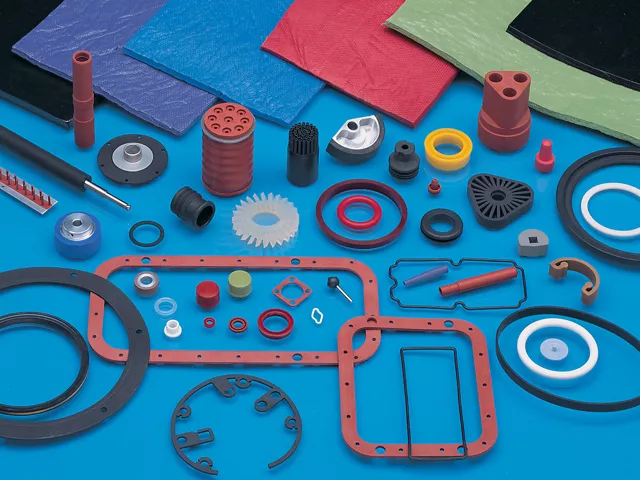
Materials choice, it doesn’t always have to be black.
Perfluoroelastomers (FFKM)
DP Seals has extensive expertise in perfluoroelastomer rubber materials (FFKM). As fully fluorinated polymers, these advanced rubber materials provide an exceptional combination of high-temperature stability and outstanding chemical resistance. This makes them a preferred choice for sealing solutions operating in the most demanding environments.
Perfluoroelastomer rubber materials are widely used for fuel system seals, lubrication seals, and connectors exposed to aggressive chemicals and extreme temperatures. Their durability and reliability make them particularly suitable for industries such as aerospace, energy, chemical processing, and advanced manufacturing.
Recent advances in material compounding have also introduced alternative rubber materials that deliver strong performance while offering more cost-effective solutions for certain applications.
Viton Extreme
FKM rubber materials are well known for their high-temperature performance and excellent resistance to chemicals, mineral oils, ozone, and sunlight. However, traditional FKM compounds can experience limitations when exposed to high-pH chemicals such as bases.
New compounds such as Viton Extreme (ETP 600S) address these challenges by improving resistance to aggressive chemical environments. These advanced fluoroelastomer rubber materials provide enhanced tensile strength, superior compression set resistance, and reduced volume swell. As a result, they help extend seal life and improve wear resistance in demanding applications.
These characteristics make Viton Extreme rubber materials particularly suitable for fuel systems, lubrication systems, and other industrial sealing applications where durability is critical.
Optimized HNBR
Recent developments in HNBR rubber materials have significantly expanded their performance capabilities. Optimized HNBR compounds now offer a performance range that approaches that of FFKM rubber materials while remaining considerably more cost-effective.
These advanced rubber materials maintain excellent high-temperature resistance while extending low-temperature performance down to -50°C. This makes them well suited for equipment operating in extreme climates, including Arctic-type environments.
In addition to temperature resistance, optimized HNBR rubber materials also provide excellent abrasion resistance. This combination of durability and cost efficiency gives engineers a strong alternative to perfluoroelastomer rubber materials in many applications.
Cutting-Edge Polymer Development
DP Seals continuously explores new rubber materials and polymer technologies through an ongoing research and development program. The goal is to better understand both the performance characteristics of emerging materials and their behavior during molding and manufacturing.
By investigating advanced compounds and innovative material combinations, DP Seals helps customers select rubber materials that deliver optimal performance for their specific applications.
Carboxylated Nitrile
Carboxylated nitrile rubber materials offer improved abrasion resistance compared to standard nitrile compounds. The addition of carboxyl groups enhances strength and durability, making these rubber materials particularly suitable for applications requiring high wear resistance.
Nanotechnology Rubber
While Teflon-coated rubber materials have been used for many years, new developments involving nano-particle Teflon fillers are opening new possibilities. Incorporating nano-scale PTFE into fluoroelastomer rubber materials can significantly reduce friction without the flexibility loss or flaking sometimes associated with traditional coatings.
Fluorosilicone
Fluorosilicone rubber materials provide excellent performance in low-temperature environments, maintaining flexibility down to -60°C. At the same time, they offer improved chemical resistance compared to standard silicone rubber materials.
This balance of temperature performance and chemical resistance makes fluorosilicone rubber materials particularly valuable in aerospace, automotive, and fuel system applications.
HPLT: High-Pressure, Low-Temperature FKM
As oil and gas exploration expands into Arctic and Antarctic regions, the need for rubber materials capable of withstanding high pressure and extremely low temperatures continues to grow.
DP Seals has partnered with Solvay Specialty Polymers to develop advanced HPLT FKM rubber materials designed specifically for these conditions. These materials feature a glass transition temperature of -40°C and improved chemical resistance, making them suitable for demanding environments.
DP Seals is already producing aerospace and subsea molded components using these advanced rubber materials for clients operating in highly challenging environments.